Water Damage Restoration in California
Water damage restoration in California starts with the first hour: stop the source if it’s safe, stay away from anything electrical that’s wet, photograph everything, and call a restoration company the same day. Wet materials start to break down quickly, and the EPA advises drying water-damaged areas within 24 to 48 hours to prevent mold. This page follows the order you’ll need things: what to do right now, who to call, what drives the cost, and what insurance usually covers.
Water Damage Emergency? What to Do First
If water is still coming in, do three things in this order: make the area safe, stop the source, and document the damage. Then call for help. Every hour that building materials stay wet makes the repair bigger, so a fast call matters more than a perfect cleanup.
What to Do Immediately After Discovering Water Damage
Get everyone, including pets, out of the wet area. If it’s safe, stop the source by closing the shutoff valve at the leaking fixture or appliance. Lift small valuables, electronics, and papers off wet floors.
Before you move or throw anything away, take wide and close-up photos and a short video of every affected room. Then call a restoration company and your insurance company. Towels and fans help with a small spill, but they don’t dry what is already inside walls and subfloors.
When to Shut Off the Water Supply and Electricity
Water: close the fixture shutoff first. If you can’t find it or it doesn’t stop the flow, close the main water valve for the property.
Electricity: if water is near outlets, appliances, light fixtures, or the electrical panel, turn the power off at the breaker only if the panel is dry and you can reach it without standing in water. If you can’t, stay out and call your utility company or a licensed electrician. Never touch a wet appliance that is still plugged in.
When to Avoid Entering a Flooded or Unsafe Area
Stay out if any of these apply:
- Water is touching electrical equipment or outlets
- The ceiling is sagging or bulging with water
- Floors feel soft, sloped, or are lifting
- There is a sewage smell, or the water came from outside flooding or a backup
Standing water can hide hazards and carry bacteria. Don’t use a regular household vacuum on it.
When to Call a Professional Water Damage Restoration Company
Call a professional if:
- Water has pooled or spread into more than one room
- Materials have been wet for more than a day
- The water came from a toilet, drain, sewer line, or outside flooding
- Flooring, drywall, or baseboards are warping, staining, or feel soft
- You smell mustiness or suspect water inside a wall or under the floor
The main exception is a small, clean spill on a hard surface that you can dry completely within a day.
Need help right now? See how emergency water damage response works in San Diego.
Can I do water restoration myself?
For a small, clean-water spill that you can dry completely within a day or two, often yes: remove the water, move items out, and run fans and a dehumidifier. The EPA advises drying water-damaged areas and items within 24 to 48 hours to prevent mold growth.
Don’t go DIY if the water is sewage or floodwater, if electrical equipment is involved, or if water has gone into walls or under flooring. Hidden moisture needs meters to confirm it’s gone, and a wall that only looks dry is the usual way problems return.
What Information to Prepare Before Calling for Help
Having these ready speeds up the call:
- Property address, property type, and whether you own or rent
- Where the water came from, and whether it has been stopped
- When it started and which rooms or materials are wet
- Photos or video you’ve already taken
- Your insurance company, and a policy or claim number if you have one
Professional Water Damage Restoration Services in California
Water damage restoration in California is the full job of removing the water, drying the structure, confirming it’s actually dry, and repairing what was damaged. If you’ve been wondering what water damage restoration involves beyond “getting the water out,” these are the services it covers. The emergency part, often called water mitigation, comes first. Rebuilding comes last.
Emergency Water Removal and Extraction
Pumps and extraction equipment remove standing and bulk water as fast as possible. This stops the damage from spreading and limits how much water soaks into materials. Extraction alone does not make a space dry, because water remains inside flooring, framing, and walls.
Structural Drying and Dehumidification
Air movers and dehumidifiers pull moisture out of materials that extraction can’t reach, including subfloors, wall cavities, and framing. The equipment is positioned based on where the moisture actually is, and it runs for days rather than hours in most losses.
Moisture Detection and Hidden Water Damage Assessment
Moisture meters measure what is inside a material, and thermal imaging helps flag cooler, wetter areas behind surfaces. Together they locate water behind walls, under floors, and above ceilings that looks fine from the room.
Water-Damaged Walls, Ceilings, Floors, and Building Materials
Each material reacts differently. Hardwood can cup, laminate can swell, drywall can soften, and insulation holds water. Some can be dried in place; materials that are saturated, contaminated, or won’t reach a dry reading are usually removed.
Water-Damaged Furniture and Personal Belongings
Items are sorted into what can be cleaned and dried and what can’t be safely saved. Solid wood and hard items are often recoverable. Upholstered pieces, mattresses, and anything soaked with contaminated water are much less likely to be.
Mold Prevention and Moisture-Related Concerns
Fast, verified drying is the main way to lower mold risk. If mold is already growing, that is mold remediation, a separate job from water removal and drying, and it needs its own scope and containment.
Cleanup, Repairs, and Reconstruction
Once the structure is dry, surfaces are cleaned and damaged materials are repaired or replaced. Water damage cleanup and repair often cover drywall, paint, flooring, baseboards, and cabinetry. This phase is commonly scoped and priced separately from drying. For a closer look, see our San Diego water damage cleanup page.
Residential Water Damage Restoration
Houses, condos, and apartments each present different problems: slabs and crawl spaces, shared walls and plumbing, or a leak that started in the unit above. Residential work usually involves coordinating with the homeowner, landlord, or HOA and the insurer.
Commercial Water Damage Restoration
Commercial losses mean larger areas, inventory and equipment, and pressure to reopen. Good commercial work is planned around business operations and keeps detailed records for the owner, property manager, and insurer.
Can water damage be restored?
Often yes, especially when the water is clean and the structure is dried quickly and verified with moisture readings. Hard materials like framing, concrete, and many solid-wood items usually recover well.
Materials that stay swollen or rotted, or that were soaked with contaminated water, are often replaced instead, which is why the water category and how fast you act matter so much.
Common Causes of Water Damage in California Properties
Most water damage starts with something ordinary failing. The cause matters because it decides what kind of water you’re dealing with, how fast it spread, and whether it will happen again if the source isn’t fixed.
Burst Pipes and Plumbing Failures
Aging supply lines, corroded fittings, and failed connections can release a large volume of water quickly, often inside walls or ceilings. Signs include sudden water stains, the sound of running water, or a spike in your water bill.
Leaking Appliances, Washing Machines, and Dishwashers
Supply hoses wear out, and drain lines loosen. A slow leak behind or under an appliance can run for weeks before a stain appears, which gives the water time to soak flooring and cabinets.
Water Heater Leaks and Failures
Tank corrosion or a failed valve can release a full tank into a garage, closet, or utility room. Water heaters are often tucked out of sight, so a small leak can go unnoticed for a long time.
Roof Leaks and Rainwater Intrusion
Damaged flashing, worn roofing, clogged gutters, or poor drainage let rain into attics and ceilings. Because the water often travels along framing before it shows, the visible stain may be far from the actual opening.
Storm Damage and Flash Flooding
Heavy rain can overwhelm drainage and push water into lower levels. Flood damage restoration is a different situation from a plumbing leak: the water is usually contaminated, and insurers treat flood differently from other water damage. See our San Diego page on flood damage restoration.
Sewer Backups and Contaminated Water
Backups through toilets, floor drains, or the main sewer line involve contaminated water. Don’t clean it up yourself. It requires protective gear and the removal of porous materials that can’t be made safe.
Slab Leaks and Hidden Plumbing Leaks
Leaks under a concrete slab or inside walls can run unseen. Warm spots on the floor, a rising water bill, the sound of water when nothing is running, or damp baseboards are common clues.
Overflowing Bathtubs, Sinks, and Toilets
An overflow spreads across the floor and often through to the ceiling below. Water from a clean fixture is less risky than a toilet overflow that includes waste, which should be treated as contaminated.
Basement, Crawl Space, and Foundation Water Intrusion
Groundwater, poor grading, and failing drainage can seep through foundations or collect under the house. Crawl spaces in particular can stay damp for a long time without anyone looking.
How the Water Damage Restoration Process Works
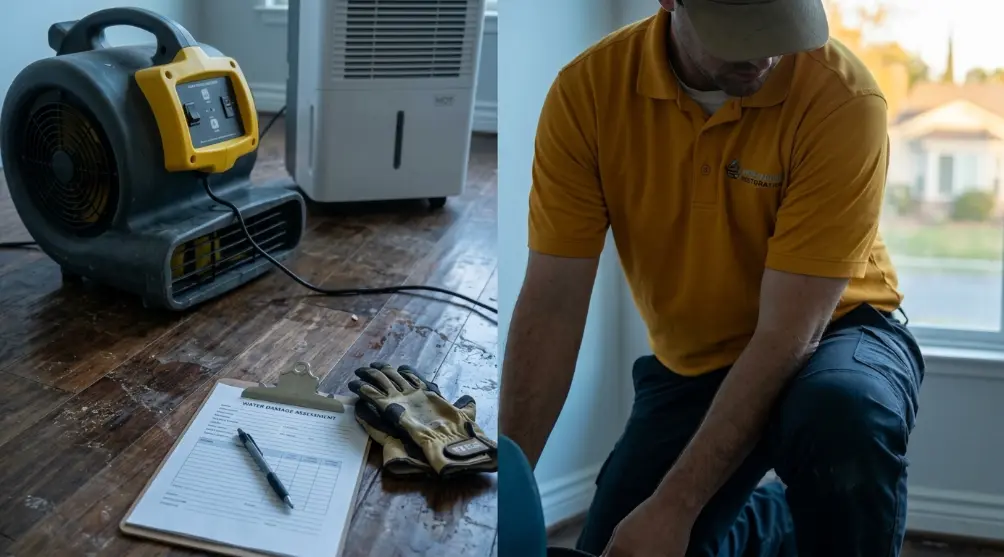
A reliable restoration follows the same sequence on every job: find the water, remove it, dry what’s left, prove it’s dry, then repair. Reputable companies base the work on the IICRC S500 standard, the industry reference for professional water damage restoration.
Step 1 — Initial Contact and Emergency Assessment
You describe what happened. The company asks about the source, when it started, what’s affected, and any safety concerns, then decides how quickly to get someone to the property. Our water damage assessment page covers what an assessment looks like.
Step 2 — Inspection and Identification of the Water Source
On site, the technician finds the source and confirms it has been stopped. Drying a structure while water is still entering only repeats the damage, so this comes before any equipment is set up. More on water damage inspection for San Diego properties.
Step 3 — Water Category, Contamination, and Damage Assessment
Water is classified as clean, gray, or black based on its source and contamination level, because that decides the safety precautions and what can be saved. The table below summarizes the three categories.
Step 4 — Water Extraction and Removal
Standing and bulk water is removed first, which limits how much moisture soaks into materials and speeds up everything that follows.
Step 5 — Moisture Mapping and Drying Equipment Setup
Readings across floors, walls, and ceilings show which areas are wet. Air movers and dehumidifiers are then placed according to that map rather than by how the room looks.
Step 6 — Structural Drying and Moisture Monitoring
Equipment runs while moisture is re-measured on a schedule. Readings tell the technician whether to move equipment, add more, or open a wall to dry a cavity.
Step 7 — Cleaning, Sanitizing, or Material Removal When Needed
Surfaces are cleaned, and materials that can’t be dried or safely cleaned are removed. Contaminated water usually means more removal and stricter cleaning.
Step 8 — Drying Verification and Documentation
Final readings are compared against dry standards for the materials involved, and the results, photos, and equipment logs are recorded. This is the proof the structure is dry, and it also supports an insurance claim.
Step 9 — Repairs, Reconstruction, and Final Handoff
Rebuilding is either completed by the company or handed off to a contractor, and you receive the project records. Ask who is responsible for each phase before work starts. See our San Diego page on water damage repair.
Water categories at a glance (IICRC S500). Water can move to a worse category the longer it sits, sometimes within 24 to 48 hours.
| Category | Typical sources | What it means |
|---|---|---|
| Category 1 (clean) | Broken supply line, clean sink or tub overflow | Lowest risk when treated fast, but it can degrade if left |
| Category 2 (gray) | Washing machine or dishwasher discharge | Contains contaminants; more caution and more material removal |
| Category 3 (black) | Sewage, backups that include waste, outside floodwater | Grossly contaminated; strict precautions, porous materials usually removed |
How Long Does Water Damage Restoration Take?
There isn’t one honest number for how long water damage restoration in California takes. Drying is often a matter of days rather than hours, and repairs can add more time, but the actual timeline depends on the factors below and becomes clearer once moisture readings are taken. Drying is finished when the readings say so, not when a set number of days has passed.
How long does restoration take after water damage?
Drying commonly takes days rather than hours, and repairs can add more time on top of that. The real timeline depends on the amount of water, the materials, and whether moisture is hidden, and it’s confirmed by moisture readings rather than a set number of days.
Factors That Affect the Restoration Timeline
The amount of water, how long it sat, the size of the affected area, the materials involved, whether moisture is hidden, and the indoor temperature and humidity all matter. Two rooms that look the same on day one can dry at very different speeds.
Water Extraction Versus Structural Drying Time
Extraction is usually the shorter phase, and structural drying is usually the longer one. Pulling water out can be done in hours; getting moisture out of framing and subfloors takes longer. The comparison table below shows the difference.
How the Type of Water and Building Materials Affect Drying
Dense materials like hardwood, concrete, and plaster release moisture slowly, while carpet and drywall react quickly but may not recover. Contaminated water adds cleaning or removal steps, which extends the schedule.
When Walls, Flooring, or Other Materials May Need Removal
Removal is more likely when materials are saturated, contaminated, or can’t reach a dry reading. Sometimes opening a wall or lifting flooring is what allows the cavity underneath to dry, and it can shorten the overall job.
How Moisture Monitoring Helps Determine When Drying Is Complete
Repeated readings show whether moisture is dropping, holding steady, or rising. A job is complete when readings reach acceptable levels for those materials, which is more reliable than judging by touch or appearance.
Why Mold Risk Increases When Wet Materials Remain Undried
Mold needs moisture. The EPA advises drying water-damaged areas and items within 24 to 48 hours to prevent mold growth, and notes that mold usually won’t grow if wet materials are dried in that window. The longer materials stay wet, the higher the risk.
| Water Extraction | Structural Drying |
|---|---|
| Removes standing and bulk water | Removes moisture held inside materials |
| Usually the shorter phase | Usually the longer phase |
| Uses pumps and extractors | Uses air movers and dehumidifiers |
| Doesn’t prove the space is dry | Ends only when moisture readings confirm it |
How Much Does Water Damage Restoration Cost in California?
The cost of water damage restoration in California depends on the scope of the loss, and no honest company can quote a fixed price for your property before someone has inspected it and measured the moisture. What you can do is understand what drives the number and what a clear estimate should show. Affordable water damage restoration is one where the scope is written down and doesn’t grow without notice, not simply the lowest number.
How much does it usually cost to fix water damage?
There’s no reliable single number. Cost depends on how much water there is, how long it sat, the water category, the materials involved, and how much rebuilding follows. Extraction and drying are usually priced separately from repairs.
The only way to get a real number is an in-person assessment and a written, itemized scope. Ask your insurer what they’ll cover before you approve a large job.
Factors That Influence the Total Restoration Cost
The main drivers are the size of the affected area, the amount of water, the water category, the materials involved, how much equipment is needed and for how long, and how much rebuilding follows. Timing matters too: an emergency call outside normal hours may be priced differently, so ask.
How the Amount of Water and Affected Area Affect Cost
More rooms and more saturated materials mean more equipment, more labor, and more monitoring visits. Water that has spread through multiple floors or into wall cavities costs more to dry than a contained spill.
How Water Contamination Can Change the Scope of Work
Gray and black water add protective measures, cleaning, and usually the removal of porous materials like carpet, padding, and drywall. A sewage or floodwater loss is generally a larger job than a clean supply-line leak of the same size.
Water Extraction and Drying Costs Versus Repair Costs
Mitigation (removal, drying, monitoring) and reconstruction (rebuilding) are different phases and are often priced separately. Be cautious of a flat per-square-foot figure quoted by phone before anyone has seen the property.
How Hidden Damage Can Affect the Initial Estimate
Moisture found behind walls or under floors after work begins can change the scope. A good company explains that possibility up front and tells you how it will document and approve changes.
What to Check in a Written Estimate and Scope of Work
Look for:
- The rooms and materials covered
- Equipment and how many days of monitoring are included
- How drying will be verified
- What’s excluded, and who handles rebuilding
Questions to Ask About Additional Charges and Changes in Scope
Ask what could trigger a change, who has to approve it and when, how it would be priced, and whether it will be put in writing before the work happens.
Why is water restoration so expensive?
The price reflects specialized drying equipment, trained labor, emergency availability, repeated moisture monitoring over several days, disposal of damaged materials, and any rebuilding. Hidden moisture found later can also expand the scope.
A clear itemized estimate shows where the money goes, and it’s the best way to tell a high price that’s justified from one that isn’t.
Is water damage restoration profitable?
For companies, it can be a viable business, but profit depends on equipment, trained staff, licensing, insurance work, and round-the-clock availability, and it varies by company and market. It isn’t a reason to expect inflated pricing.
If you’re researching the industry itself, look at IICRC training and CSLB licensing requirements.
Does Homeowners Insurance Cover Water Damage Restoration?
It depends on your policy and what caused the damage. Whether water damage restoration in California is covered by insurance often comes down to the source: homeowners policies may cover sudden, accidental water damage such as a burst pipe, but standard homeowners policies typically exclude flood. Flood coverage is separate, usually through the National Flood Insurance Program (NFIP) or a private flood insurer.
Why Coverage Depends on the Cause of the Water Damage
Insurers look at the source and how the damage occurred. A sudden plumbing failure, long-term seepage, a sewer backup, and rising floodwater can all be treated differently under the same policy. Read the sections that define water damage, flood, and backup.
Sudden Plumbing Leaks Versus Flood Damage
The California Department of Insurance notes that homeowners and commercial policies typically exclude flood, mudslide, and debris flow. Flood insurance generally must be in force for 30 days before a flood to apply in most cases.
What to Ask Your Insurance Company About Your Policy
- Is this cause of loss covered under my policy?
- What is my deductible, and is the damage likely to exceed it?
- Is sewer or drain backup covered?
- What documentation do you need, and do you require a specific vendor?
How to Document Property Damage Before Repairs
Photograph and video every affected room and item, the source if it’s visible, and the condition of materials before anything is moved. Write down when you found it and what you did. Keep a log of every conversation with your insurer.
Photos, Receipts, Estimates, and Restoration Records
Keep receipts for emergency repairs, written estimates, moisture logs, equipment records, and final reports. These show what was done and why, and they support the claim.
What to Understand Before Approving Restoration Work
The Department of Insurance advises making temporary repairs to prevent further damage, but not permanent repairs until the adjuster has seen the damage. Confirm what the insurer will pay for before signing a large scope, and remember that the restoration company doesn’t decide coverage.
How to Handle Changes in Scope During the Claim
Tell your adjuster as soon as hidden damage turns up and get the added work documented. If the insurer says something isn’t covered, ask them to point to the policy provision. For help or disputes, the California Department of Insurance consumer line is 800-927-4357.
How to Choose a Water Damage Restoration Company in California
Ask for proof, not promises. When you’re comparing water damage restoration companies, these checks separate a prepared company from one that only answers the phone. You can also read more about AWM and how we work.
Do I need a license to do water restoration in California?
California generally requires a CSLB contractor license for work totaling $1,000 or more in labor and materials, or work that needs a permit. Which parts of a water damage job fall under that depends on the work, since rebuilding or altering a structure is contractor work.
Ask the company directly which parts of your job need a license and what theirs is, then check it before signing.
How to Verify a Contractor’s License When Applicable
California generally requires a Contractors State License Board (CSLB) license for work totaling $1,000 or more in labor and materials, or work that needs a permit. Ask which parts of your job fall under that, then check the license number at cslb.ca.gov. Licensed contractors must include their license number in advertising.
What Restoration Experience and Relevant Certifications Mean
Certifications such as those from IICRC show training in industry standards, not guaranteed results. Ask who on the crew holds them and how often they handle losses like yours.
How to Confirm Emergency Availability and Response Expectations
Ask whether someone answers around the clock, how soon a technician can reach your address, and whether that time is an estimate or a commitment. Response can change during widespread storms.
What to Ask About Moisture Detection and Drying Verification
Ask whether they use moisture meters and thermal imaging, how often they re-measure during drying, and whether you’ll receive a record of the final readings.
How to Evaluate Written Estimates and Itemized Scope
Compare what each estimate includes, not only the total. Look at rooms covered, equipment, monitoring days, disposal, and exclusions, so you’re comparing like with like.
How to Check Reviews and Look for Consistent Customer Experiences
Read reviews across more than one site and look for patterns: arrival time, communication, how surprises were handled, and whether the final price matched the estimate. A few detailed reviews are more useful than many generic ones.
How to Confirm Insurance Coordination and Documentation Practices
Ask what records they provide, whether they’ll share documentation with your adjuster, and who deals with the insurer on scope questions.
Questions to Ask Before Work Begins
- What is included in the written scope, and what isn’t?
- Who will be on site and who is responsible for the job?
- How will you verify the structure is dry?
- What could change the price, and how will I be told?
Warning Signs of Unclear Pricing or Unexplained Scope Changes
Pressure to sign immediately, a lump-sum total with no breakdown, vague “additional work” language, no explanation of how drying will be verified, or large payment demands before work starts are all reasons to slow down and ask questions.
Water Damage Restoration Service Areas Across California
Searching for water damage restoration near me? In California that depends on your exact address, not just the city name, so call and we’ll confirm whether we can serve your location and what response to expect. The regions below organize where property owners contact us from for water damage restoration in California.
Southern California
Los Angeles and Surrounding Communities
Los Angeles, Santa Monica, Beverly Hills, Culver City, Pasadena, Glendale, Burbank, Long Beach, Torrance, Santa Clarita, Calabasas, and Woodland Hills. Los Angeles County includes dozens of separate cities, so give your exact address when you call.
Orange County
Anaheim, Santa Ana, Irvine, Huntington Beach, Costa Mesa, Newport Beach, Mission Viejo, Laguna Niguel, and San Clemente.
San Diego County
San Diego, Carlsbad, Oceanside, Encinitas, Escondido, San Marcos, Vista, Chula Vista, El Cajon, Del Mar, and La Mesa.
Inland Empire
Riverside, San Bernardino, Corona, Ontario, Rancho Cucamonga, Fontana, Redlands, Moreno Valley, Temecula, Murrieta, Menifee, and Lake Elsinore.
Other Verified Southern California Service Areas
Ventura County (Oxnard, Ventura, Camarillo, Simi Valley, Thousand Oaks), the Antelope Valley (Palmdale and Lancaster), and the Coachella Valley (Palm Desert and La Quinta).
Central California
Fresno and Surrounding Communities
Fresno, Madera, and Visalia.
Bakersfield and Surrounding Communities
Bakersfield and Oildale.
Central Coast Communities
San Luis Obispo and nearby Central Coast communities.
Other Verified Central California Service Areas
Stockton and other Central Valley cities. Ask us about your location.
Northern California
San Francisco Bay Area
San Francisco, South San Francisco, San Mateo, Burlingame, Oakland, Richmond, and Concord.
San Jose and Surrounding Communities
San Jose, Cupertino, and Campbell.
Sacramento and Surrounding Communities
Sacramento, Elk Grove, Roseville, Folsom, and Galt.
Other Verified Northern California Service Areas
Redding and other Northern California locations. Ask us about your location.
How to Confirm Service Availability in Your City or County
Call (781) 887-8424 or use the contact page with your street address and city. A city appearing on this page is not a guarantee of service at every address within it, and we’d rather tell you that on the phone than after you’ve waited.
What to Verify About Response Times and Local Coverage
Ask how far the nearest crew is from your property, what the realistic arrival window is, and whether it changes at night, on weekends, or during widespread storms. Ask the same questions of any company you’re comparing.
California Property and Water Damage Considerations
Water damage restoration in California has to account for a mix of risks, from plumbing failures in older buildings to storm runoff and rising groundwater. These points help you prepare and understand what you’re dealing with.
How Local Flood Risk Can Affect Property Preparedness
Flood risk varies widely across California, from coastal and river areas to hillsides and recent burn areas. Knowing your risk helps you decide on flood insurance, drainage improvements, and what to move off the ground floor before a storm.
Where to Check Official California Flood and Hazard Maps
Use the FEMA Flood Map Service Center for an official flood zone lookup by address, and the Cal OES MyHazards tool to see flood and other natural hazards for your location.
Why Flood Maps Do Not Show Every Possible Water Damage Risk
Maps show flood zones. They don’t show plumbing failures, roof leaks, appliance leaks, or local drainage problems, and water damage can happen on a property outside any mapped flood zone.
How Property Type and Building Materials Affect Restoration
Slab-on-grade homes, raised foundations, multi-story buildings, and commercial structures dry differently. Older materials and finishes may also need extra care, and some can’t be recovered once saturated.
Why the Water Source Must Be Identified and Corrected
Drying a space while a leak continues just repeats the damage. The source needs to be found and repaired, often by a plumber or roofer, before drying can be considered complete.
Why Water Damage Can Continue Behind Walls and Under Flooring
Moisture trapped in wall cavities and under flooring can keep damaging materials and supporting mold after the surface looks dry. This is why surface checks aren’t enough to call a job done.
Water Damage Remediation vs. Restoration
The two terms get used loosely, and companies don’t all define them the same way, so ask any company what is and isn’t in their scope. In general, mitigation and remediation deal with stopping and cleaning up the damage, and restoration includes putting the property back together.
What Water Damage Remediation Means
Generally the emergency and cleanup side: removing water, drying, cleaning, and addressing contamination or mold. Because some companies use the term to mean only part of the process, confirm exactly what’s included. Our San Diego water damage remediation page explains how we scope it.
What Water Damage Restoration Means
The broader process of returning the property to its pre-loss condition, including the repairs and rebuilding that happen after the drying is done.
How Water Removal and Drying Differ From Reconstruction
Removal and drying stop the damage from spreading and get the structure to a dry state. Reconstruction replaces what was lost, such as drywall, paint, flooring, and cabinets. The skills, crews, and pricing are often different.
Why Some Projects Need Multiple Types of Contractors
A mitigation crew, a plumber to fix the source, a mold specialist, and a general contractor for rebuilding may each be needed depending on the loss. Knowing who covers what avoids gaps and surprise costs.
How to Understand the Scope of Work for Your Property
Ask for the scope in writing, with each line item tied to a phase: mitigation, remediation, or reconstruction. That makes it easier to compare estimates and to match items to your insurance claim.
Why Proper Drying and Documentation Matter
A room that looks dry isn’t necessarily dry. Proper drying is confirmed with measurements, and the records from that process protect you if there is an insurance claim or a later problem.
Why Removing Visible Water Is Not Enough
Water that has soaked into framing, insulation, and subfloors remains after the surface looks dry and has to be dried out. Skipping that step is one of the most common reasons problems come back.
How Hidden Moisture Can Affect Building Materials
Prolonged moisture can warp flooring, weaken drywall, swell wood, corrode fasteners, and support mold growth, often out of sight.
Why Drying Equipment Must Be Monitored
Conditions change daily. Without monitoring, equipment may be left in the wrong place, run longer than needed, or be removed before the structure is actually dry.
How Moisture Readings Help Verify Drying Progress
Readings taken on a schedule show whether moisture is dropping, and the final readings document that materials reached acceptable levels. This record is useful to you and to your insurer.
What Records to Request at the End of Mitigation
- Moisture readings, including final readings
- Equipment logs showing what ran and for how long
- Photos before, during, and after
- The scope of work completed and notes on any materials removed
When Further Inspection or Remediation May Be Needed
If you notice musty odors, discoloration, or new staining after drying, get it inspected. The EPA notes that no federal limits exist for mold, so sampling can’t be used to check compliance, which makes a visual and moisture assessment the practical first step.
How to tell if water damage is permanent?
Warning signs after drying include flooring that stays warped or buckled, drywall that is soft or crumbling, persistent staining or odor, rusted fasteners, and rotted wood.
You can’t judge by looking alone. Moisture readings and an inspection show what can be saved and what needs to be replaced.
Frequently Asked Questions About Water Damage Restoration in California
Short answers to the most common questions about water damage restoration in California. For longer guides, visit our water damage restoration blog.
How quickly should I contact a restoration company after water damage?
As soon as the source is stopped, or right away if you can’t stop it. The EPA advises drying water-damaged areas and items within 24 to 48 hours to prevent mold growth, so a same-day call gives you the most options.
Can water damage be repaired without replacing drywall?
Sometimes. Drywall wet with clean water that can be dried and verified with moisture readings may be kept. Drywall exposed to contaminated water, or that stays wet, is often removed.
How do I know if water is trapped behind a wall?
You often can’t tell by looking. Staining, bubbling paint, warped baseboards, a musty odor, or a soft wall are clues. A moisture meter or thermal camera can confirm what’s behind the surface.
Can I stay in my home during water damage restoration?
Often yes for small, clean-water losses in part of the home. Contaminated water, large affected areas, or no safe power or water may mean staying elsewhere. Ask after the assessment.
Is every type of water damage a mold risk?
Any water damage can lead to mold if materials stay wet. The risk is lower when materials are dried quickly and thoroughly, and higher when moisture is hidden or prolonged.
Does water damage restoration include repairs and reconstruction?
Not always. Mitigation covers water removal, drying, and monitoring. Rebuilding drywall, flooring, or cabinetry is reconstruction and is often scoped and priced separately.
Should I contact my insurance company before hiring a restoration provider?
Yes, report the loss promptly and ask what they require. Don’t delay emergency steps that stop further damage, and document everything before and during cleanup.
How can I verify whether a company serves my California location?
Ask directly, giving your city and street address, and ask how soon a technician can be on site. Don’t rely on a city name appearing on a website.
Get Help With Water Damage at Your California Property
For water damage restoration in California, call now if water is still present or spreading. If it has already stopped, you can schedule an assessment at a time that works for you.
Explain the Water Damage and Its Location
Tell us what happened, where the water came from, how long ago, and which rooms or materials are affected. For active water damage, call (781) 887-8424 or read about emergency water damage help.
Confirm Service Availability for Your City
Give us your city and street address so we can confirm we cover your location, and what response time to expect, before anything is scheduled.
Ask About Inspection, Scope, and Expected Next Steps
Ask what the inspection involves, what the scope is likely to include, and what happens after the first visit. Our property assessment page explains the first visit in more detail. For non-emergencies, use the contact page.
Request Written Pricing and Documentation Details
Ask for a written scope and pricing, and for the records you’ll receive when the work is done, including moisture readings and photos.
AWM Water Damage Restoration — Office: 3919 30th St, San Diego, CA 92104
About Us | Privacy Policy | Disclaimer